




Property Tax Assessment Appeals
Residential Property Examples
How Residential Property Owners Can Win by Filing a 2027 Property Tax Assessment Appeal.
A lower common level ratio (CLR) will go into effect in Allegheny County for tax year 2027, bringing the potential for major tax savings to commercial property owners — and a short window to take advantage of it.
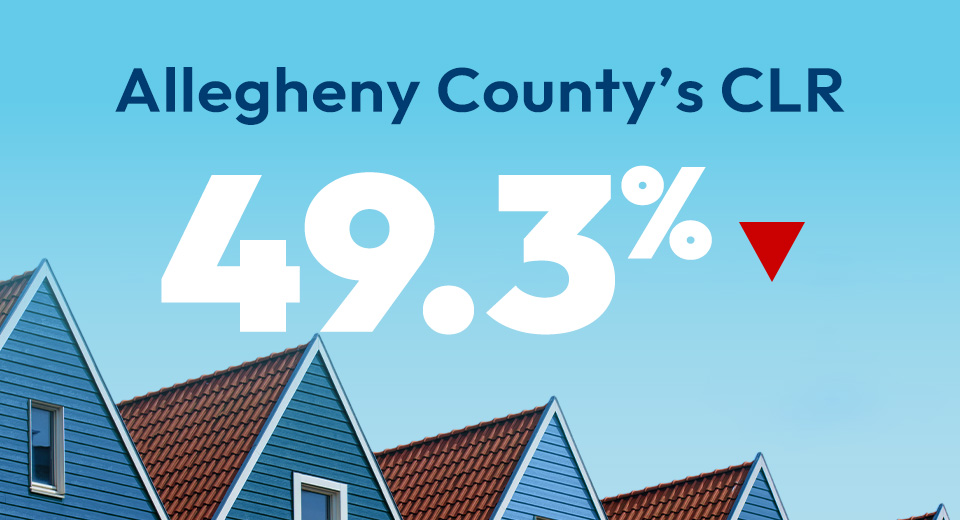
Allegheny County’s common level ratio (“CLR”) will drop to 49.3% in 2027. Allegheny County’s CLR is the factor used to convert a property’s market value into assessed value. Property taxes are based on assessed value. Over the last five years, the CLR has come down significantly from 86.2% in 2021.
However, assessed values will not automatically be adjusted by the new 49.3% CLR. Property owners must file a 2027 tax assessment appeal in order to get the benefit of the change in the ratio.
To illustrate, here are just two examples of how, over time, a residential property’s assessed value can change from “fair” to “over-assessed”.
Example 1:
The Hidden Cost of an Old Assessment: Is Your Tax Bill Too High?
Jim bought his home (the “Property”) in 2020 for $900,000. The following year, the taxing authorities used that sale to reassess the Property to $775,800 based on the 2021 Common Level Ratio (CLR) of 86.2%. Jim will pay property taxes on $775,800 in assessed value.
Fast forward to tax year 2027 – Jim’s Property is still assessed at $775,800. An assessed value of $775,800 in 2027 means the Property is being taxed as though it is currently worth $1,573,600 (based on the 49.3% CLR). If the Jim’s Property is worth less than $1,573,600, the Property’s assessed value of $775,800 is too high in 2027. Jim should file a tax assessment appeal to reduce his assessed value and lower his property tax bill.
Example 2:
New Purchaser Saddled with an Existing Unfavorable Assessment
Sue purchased the Property from Jim in March 2026 for $1,000,000. The Property continues to be worth $1,000,000 heading into the 2027 tax year. However, the Property still remains assessed at $775,800 even though it should drop to $493,000 (based on the 49.3% CLR). A reduction to $493,000 would result in significant property tax savings for Sue.
However, the County will not automatically make this adjustment. Because lowering assessments reduces tax revenues, no taxing authority will initiate this change. Sue may also be able to argue for other market values depending various methods of valuation. Unless Sue files a 2027 tax assessment appeal, the Property’s assessed value will remain at $775,800, and Sue will continue paying too much in taxes.
Making the Decision That’s Best for You
Meyer, Unkovic & Scott LLP has substantial experience representing commercial, industrial, income producing, and residential property owners in handling tax assessment appeals of all property types. For more information about tax assessment appeals, please contact Jason Yarbrough at 412-456-2592 or [email protected]. He can help you evaluate whether your property can benefit from a property tax assessment appeal.

Jason M. Yarbrough
Partner
Jason M. Yarbrough is a Partner and Chair of the firm’s Real Estate Litigation Section, Co-Chair of the firm’s Summer Associate Program, and a member of the firm’s Construction Law, Creditors’ Rights & Bankruptcy, Energy, Utilities & Mineral Rights and Litigation and Dispute Resolution Practice Groups.
Jason frequently represents clients in complex commercial, real estate and construction disputes. His real estate litigation practice includes disputes involving the acquisition and development of real property, landlord tenant disputes, property rights, property tax assessment appeals and exemption proceedings, land use and title disputes, partition actions and foreclosure proceedings. In his construction practice, Jason represents owners, developers, contractors, architects, and engineers in disputes arising out of both public and private construction projects. He has litigated claims in state and federal courts, and against state agencies and the federal government.