




Property Tax Assessment Appeals

Property Tax Assessment Appeals

Everything You Need To Know About 2027 Allegheny County and Pennsylvania Tax Assessment Appeals

The Allegheny County 2027 Appeal Deadline is now September 1, 2026.

A lower common level ratio (CLR) will go into effect in Allegheny County for tax year 2027, bringing the potential for major tax savings to property owners — and a short window to take advantage of it.

Contact Jason Yarbrough For Your Property Tax Assessment Appeals

For further information on the potential benefits, and the risks of filing a tax assessment appeal, please read the following information:

Please fill out the form if you would like someone to follow-up with you, or you can reach out to Jason Yarbrough directly at [email protected] or 412-456-2592

Frequently Asked Questions

Get answers to some frequently asked questions about how an updated CLR can impact assessed values and property taxes:

Each county in the state of Pennsylvania will determine its own appeal deadline.  

The Allegheny County 2027 property tax assessment appeal deadline is September 1, 2026.

For a list of deadlines in other counties, click here.

Every county has a “base year” for tax assessment purposes. Property assessments are supposed to reflect a base year valuation.

The base year for Allegheny County is 2012. The CLR is a ratio which is intended to convert present day market values into base year assessed values.

The CLR in each county is adjusted annually based on sales data selected in their county.

The CLR is adjusted each year to take into account changes in property valuation.

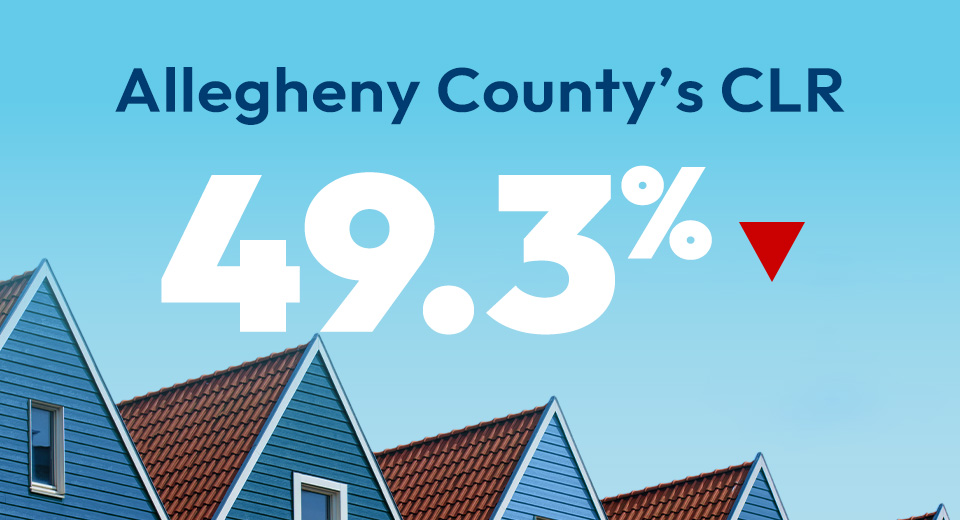
In 2027, Allegheny County’s CLR will drop to 49.3%.  With the new CLR, a property with a 2027 market value of $1,000,000 should be assessed at $493,000.  In 2024, the same property would have been properly assessed at $541,000.

Taxing authorities will only seek a change in assessed value when it works to their benefit.  This typically occurs when a property is sold or a material improvement to the property is made.  In the context of a sale, the taxing authorities are essentially asking for a new assessment “snapshot” to be taken.  The applicable CLR which exists is used during this “snapshot”.  Without a tax appeal, the property’s assessed value can remain the same for many years. 

Yes, CLR applies to commercial, industrial, and income producing properties.

When it works to their benefit, taxing authorities chase new sales and seek an increase in assessed value. In doing so, the taxing authorities are essentially asking that a new “snapshot” of market value be taken and the current CLR applied to the purchase price of the property. 

The deadline for each county in Pennsylvania varies.  The deadline to file a property tax appeal in most Pennsylvania counties ranges between August 1, 2026, and October 1, 2026.  In Allegheny County, the 2027 deadline is September 1, 2026. 

No, you must file a tax assessment appeal to reduce your assessed value. If you are over-assessed and overtaxed, the taking authorities will not reduce your assessed value. Taxing authorities only appeal property values when they believe they can obtain an increase in assessed value, resulting in higher property taxes.

Property taxes are based on assessed value. Assessed values are taxed at the millage rates set by your county, school district, and local municipality. Assuming no change in millage rates, a lower assessed value means lower property taxes.

Taxing authorities may increase their millage rates to avoid a large drop in tax revenue resulting from fewer assessed dollars. If millage rates increase, each assessed dollar will be taxed more. In a rising millage rate environment, property owners will see tax increases unless they can reduce their assessed value via a tax assessment appeal.

The answer to this question will vary based on each property’s use, market value, current assessed value, improvements made to the property, and the strategies available to obtain a reduction for that property. The attorneys in Meyer, Unkovic & Scott’s Real Estate Group have substantial experience representing property owners with property tax assessment appeals throughout Pennsylvania.

Our broad range of experience includes handling appears for clients in virtually every type of property, including:

  • Apartment complexes
  • Banks
  • Condominiums
  • Convention centers
  • Hotels
  • Industrial plants
  • Life science facilities
  • Multifamily housing
  • Office towers
  • Restaurants
  • Retail establishments
  • Shopping centers, malls, and strip malls
  • Single family residences
  • Storage facilities
  • Tax exemptions for charitable, educational, religious, trade, and other uses
  • Warehouses

Contact us to see if an assessment appeal would benefit you.

Note: these name fields do not accept spaces.

By providing a telephone number and submitting this form you are consenting to be contacted by SMS text message. Message & data rates may apply. Message frequency may vary. You can reply STOP to opt-out of further messaging. Reply HELP for more information. Please refer to our Privacy Policy.

Contact Jason Yarbrough For Your Property Tax Assessment Appeals

Jason M. Yarbrough

Partner

Jason M. Yarbrough is a Partner and Chair of the firm’s Real Estate Litigation Section, Co-Chair of the firm’s Summer Associate Program, and a member of the firm’s Construction Law, Creditors’ Rights & Bankruptcy, Energy, Utilities & Mineral Rights and Litigation and Dispute Resolution Practice Groups.

Jason frequently represents clients in complex commercial, real estate and construction disputes. His real estate litigation practice includes disputes involving the acquisition and development of real property, landlord tenant disputes, property rights, property tax assessment appeals and exemption proceedings, land use and title disputes, partition actions and foreclosure proceedings. In his construction practice, Jason represents owners, developers, contractors, architects, and engineers in disputes arising out of both public and private construction projects. He has litigated claims in state and federal courts, and against state agencies and the federal government.


How Can We Help You?

Scroll to Top